
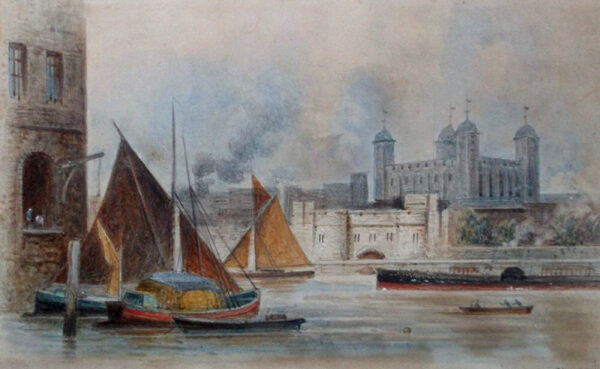
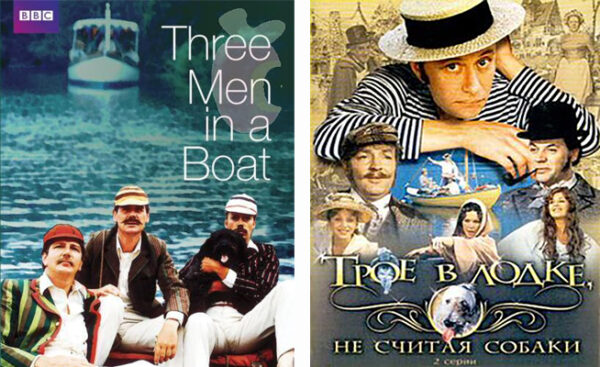
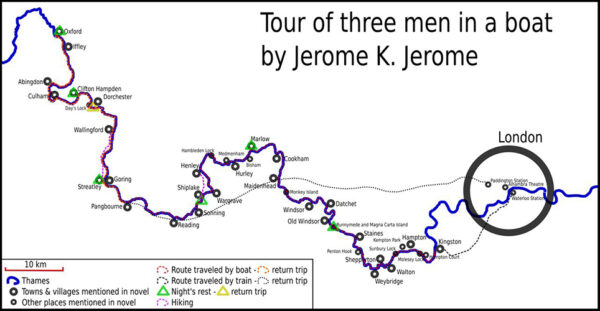
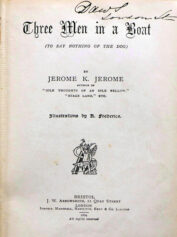
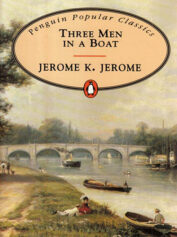
“Three Men in a Boat” was written in 1889 by the English author Jerome K. Jerome. The book offers a humorous, narrative account of a two-week boating holiday among friends. Although it was originally intended to serve as a serious travel guide to the River Thames, the abundance of comedic content soon overshadowed the informative sections, transforming it into a classic work of comic fiction. Jerome K. Jerome was born in May 1859 in Walsall, England. Over the course of his life, he held various jobs, including railway clerk, teacher, actor, and journalist. At the age of 25, he began to gain recognition by publishing humorous anecdotes about his experiences with a theater troupe in a magazine. “Three Men in a Boat” was initially serialized in that same publication. The inspiration for the novel struck after Jerome returned from his honeymoon, which he had spent boating on the Thames. In the story, however, his close friends George and Harris take the place of his wife. The book skillfully blends humorous adventures with historical and cultural references to the River Thames, resulting in a timeless and much-loved literary work. In 1898, nine years after the publication of “Three Men in a Boat”, Jerome’s brief stay in Germany inspired “Three Men on the Bummel”, a sequel that reunites the same characters on a cycling tour abroad. However, this follow-up struggled to recapture the sheer comic vitality and historical resonance of its predecessor—largely due to the absence of the unifying symbol of the River Thames. As a result, Bummel achieved only moderate success by comparison. Nevertheless, several of its standalone comic episodes have been praised as highly as those in Boat. The influence of the classic travelogue Three Men in a Boat on tourism in the region was so profound that, within a year of its release, the number of registered boats along the route had increased by fifty percent. To this day, readers flock to the area to retrace the journey described in the book, frequenting the pubs and landmarks immortalized in its pages. Except for two sites mentioned in the text, most of these locations still retain their original names. There are approximately twenty different cover designs for the book, and it has even been interpreted as a graphic novel. Between 1920 and 2006, multiple film and television adaptations were produced—two of which have gained particular acclaim. “Three Men in a Boat” brought its author remarkable fortune. The book was reprinted numerous times in England, allowing Jerome to become a full-time writer on the strength of its success. Although he went on to write other novels and plays, none would replicate the triumph of this singular work. As the title suggests, the story follows three young clerks—and a dog—as they embark on a boating trip. Seeking escape from the routines and pressures of urban life, they set out on a two-week journey in an open skiff, traveling upriver from Kingston to Oxford along the Thames. By the end of the voyage, however, rain, cold, and a series of misadventures make their return to London a very different sort of passage. The author and his friends had overly romanticized nature. Their inexperience, coupled with overpacking, leaving behind essential items, cold and rainy weather, and so on, led to a story full of hilariously unfortunate incidents such as falling into the river, getting lost in a maze of paths, going hungry, and more. Circumstances conspired to make even basic life activities challenging. “Three Men in a Boat” is a narrative with a loose structure, primarily driven by the journey itself and the characters’ humorous observations along the way. The novel is largely about the jokes and reflections of the characters during their boating trip on the Thames. The focus is on Jerome’s narration, his self-deprecating and humorous observations, and his interactions with George, Harris, and his dog, Montmorency. The book comprises a series of vignettes or episodes, each focusing on a particular event, observation, or interaction of the characters during their boating trip. These episodes are not necessarily connected in a linear plot but explore different aspects of their journey and their personalities. The tone of the book is humorous and observational. Many situations are exaggerated or depicted for comedic effect. The humor often stems from the characters’ misfortunes, misunderstandings, and inability to manage the practical aspects of boating. While the physical journey along the River Thames is a key element of the story, it also serves as a metaphor for the characters’ lives and their attempts to find peace and escape the pressures of city life. In fact, George decides to suggest a trip to his friends to avoid the excessive pressure of work on their minds, which has caused their depression. He believes that “a change of scenery and not having to think will restore mental health…”. The book has been translated into many languages and published in large print runs. In Russia, it achieved such popularity that it became a textbook. In Iran, it reached its 91st printing by Rozaneh Publications by 2008 (1387-Iranian calendar). In 2007 (1386-Iranian calendar), the book was also published by Moein Publications, translated by Omran Salahi. An audiobook narrated by Saman Ehtesham is also available. A curated visual album of selected cover designs for “Three Men in a Boat” is now available through the link provided—a pictorial voyage into the world of Jerome K. Jerome’s novel. From vintage and classic editions to modern and imaginative reinterpretations, each cover captures a fragment of the book’s enduring humor and charm. Some portray the three main characters and their famous dog, Montmorency, boating along the Thames; others reflect the subtleties of Victorian satire. Together, they form a visual tribute to one of the most timeless comic masterpieces in literary history. Robert McCrum¹, acclaimed British writer and critic, has written in The Guardian that “Three Men in a Boat” is about youth, the absurdity of existence, holidays, camping, schoolboy high jinks, comic songs, and the poignant memory of time lost. Like all great works of comic literature, it is a book about everything—and nothing. The Daily Telegraph praises the story for its surprisingly modern and delightful tone. The Independent calls it “a charming comic tale of friendship and human nature,” while The Guardian hails it as “a classic masterpiece that shines like a diamond in the comic genre.” Notably, the novel is listed among The Guardian’s greatest English novels. Despite being published over two centuries, one of the remarkable qualities of “Three Men in a Boat” is how fresh and relevant it still feels to contemporary readers. Its jokes and humorous episodes remain vivid and widely quoted. That said, a glance through reader reviews on platforms like GoodReads reveals that not all readers are equally enchanted—some find the humor outdated or slow-paced. After all, the humor is that of 1899. Three Men in a Boat (To Say Nothing of the Dog)
A Humorous Journey on the River Thames
Travel as a Metaphor

¹Robert McCrum is an experienced author and literary critic, formerly of Faber & Faber and The Observer.